TalkFR • Academic Project 2025
Designing for real talk beyond translation into meaning
TalkFR ( Talk For Real ) is an AI- powered slang-learning app designed to help international student or ESL ( English as Second Language ) learner confidently understand and use contemporary English expressions in real-life communication.
ROLE
Lead Product Designer
TIMELINE
4 months, 2025
TEAM
Lead Product Designer ( me )
1 User Researcher
2 Designers
PROJECT TYPE
App Design
Edtech
WHAT I DID
• Led product design and visual design from concept to 7+ high- fidelity prototype.
• Conducted 2 user interviews and 3 moderated usability tests to validate flows and usability issues.
• Developed a design system that improved speed, consistency, and collaboration across the team.
BACKGROUND
What if we leveraged AI to provide personalized slang tutoring, helping learners go from not sure to confident in real talk?
What if we leveraged AI to provide personalized slang tutoring, helping learners go from not sure to confident in real talk?
International students often learn formal English but struggle with the informal expressions that native speakers use every day, such as slang, internet abbreviations, and casual conversational phrases, making it difficult to understand jokes, follow social interactions, and participate in casual conversations. This gap for feeling socially isolated, less confident in speaking was the starting point for TalkFR.
SOLUTION
TalkFR: An AI-powered slang tutor providing tailored feedback and guidence.
Learn slang with usage, scenarios and related media
Learn slang with usage, scenarios and related media
Provides tailored AI learning modes based on user context
Provides tailored AI learning modes based on user context
Instantly lookup the slang word without switching the app
INITIAL OBSERVATION
Nearly 80% of respondents have pretend to understand slang because they don’t want to interrupt the flow of the conversation.
We conducted user survey and user Interview with non-native english speakers to ensure that we were addressing our users’ needs and uncover pain points:
32
Survey respondents
Survey respondents
5
Depth user interviews
Depth user interviews
PAIN POINTS:
1. Lack of strategies for learning slang
Most time stop at one-time translation. Users want ongoing learning and simple ways to explore more related slang.
Uncertainty about slang usage
Even when users understand the meaning, they still hesitate to use slang because they’re unsure about tone, politeness, and fear sounding awkward.
3. Slang lookup creates friction
Switching between multiple apps to search slang breaks immersion so that users often give up looking it up.
COMPETITOR ANALYSIS
Guided Slang Learning in Real-Life Contexts
We mapped language-learning apps, translators, and dictionaries across two dimensions. Slang in real-life context and level of practice & guidance to identify where TalkFR can uniquely deliver slang-first learning beyond one-time lookup.
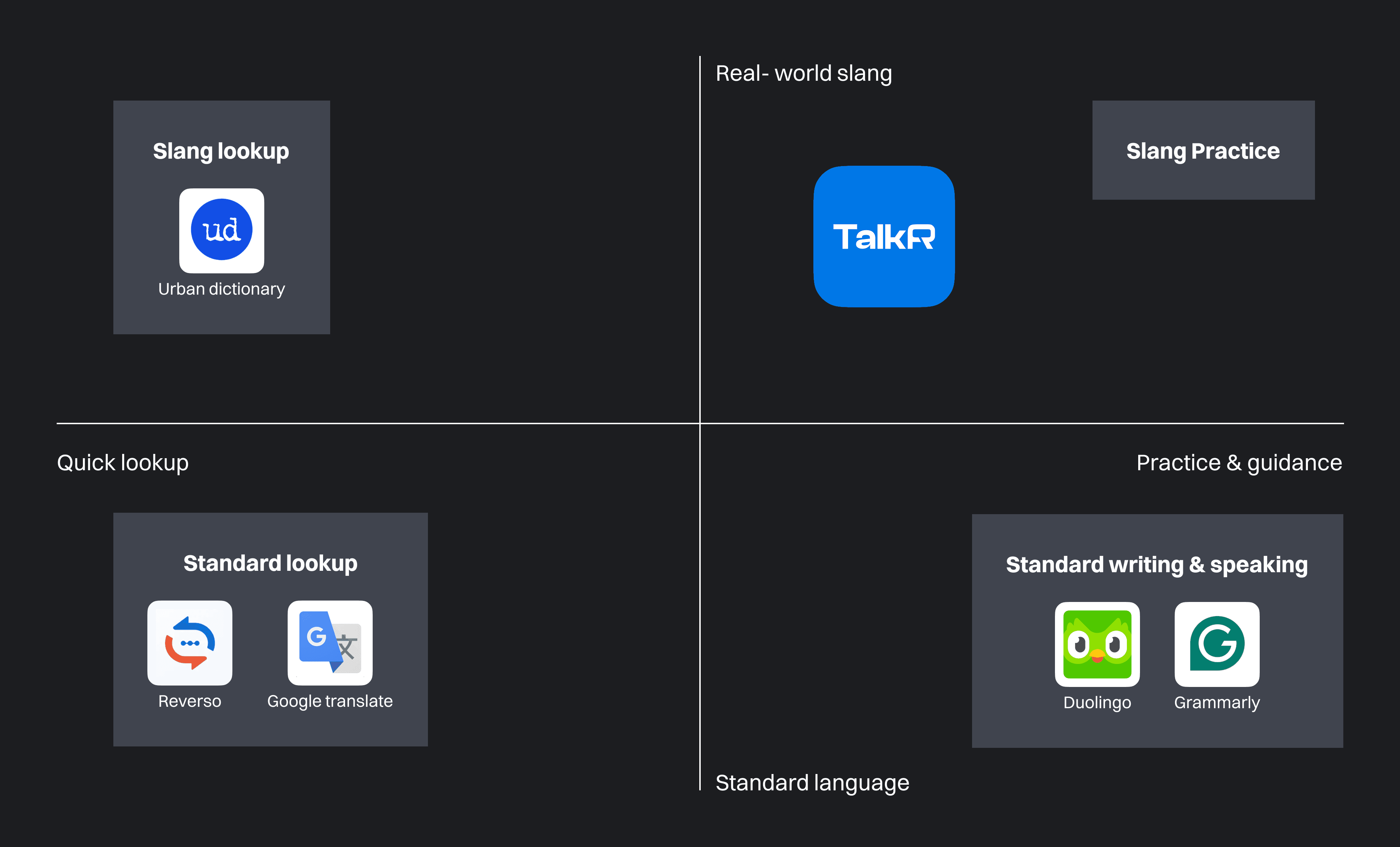
Most tools end at lookup or focus on standard language practice, here are key opportunities that TalkFR is designed to filled:
1. Interactive slang practice
Few competitors offer real-time, contextual slang practice. TalkFR can fill this gap with AI chat and games.
Cultural differences and taboos
Provide cultural notes to prevent misuse, such as flagging when certain slang may be offensive or only used within specific groups.
3. Slang trend updates
Introduce new slang terms and their meanings, proactively helping users stay up to date with the latest usage.
“ How might we turn a quick slang lookup into an ongoing, personalized learning experience? ”
“ How might we turn a quick slang lookup into an ongoing, personalized learning experience? ”
DESIGN PROCESS
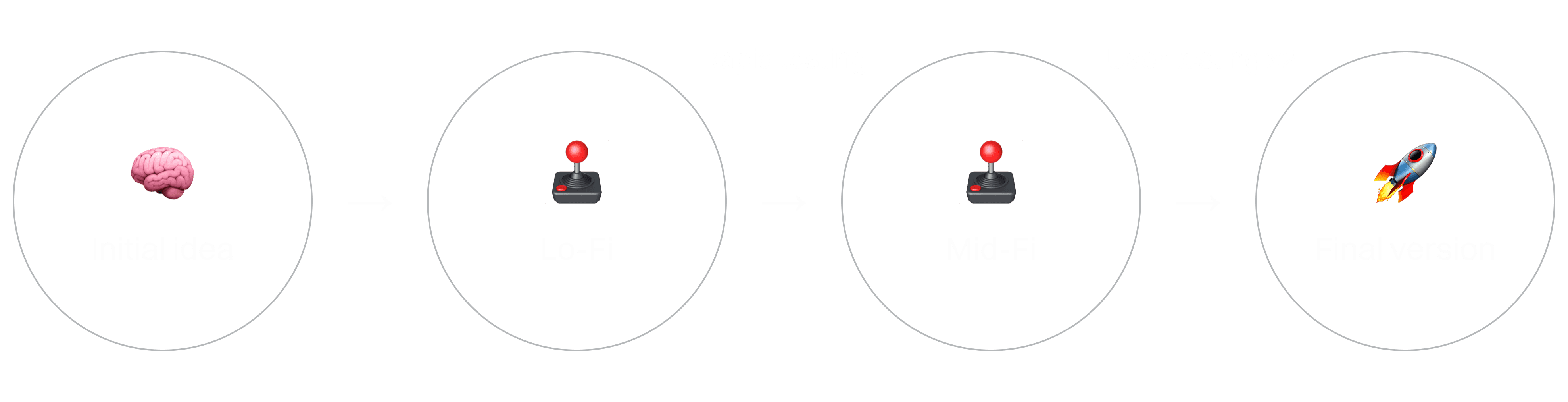
Validated key decisions with rapid testing to iterate the product direction quickly.
INITIAL IDEAS
Key features: Searching, Learning, and Tutoring
Based on our initial observation, we started brainstorming with these key features: Search Feature for users to quickly find definitions and examples, Game/Learning Hub to practice using slang, and a TalkFR Mascot to be a personal coach on the user’s learning journey.
LO-FI WIREFRAMES & TEST
Validate the concept and direction early
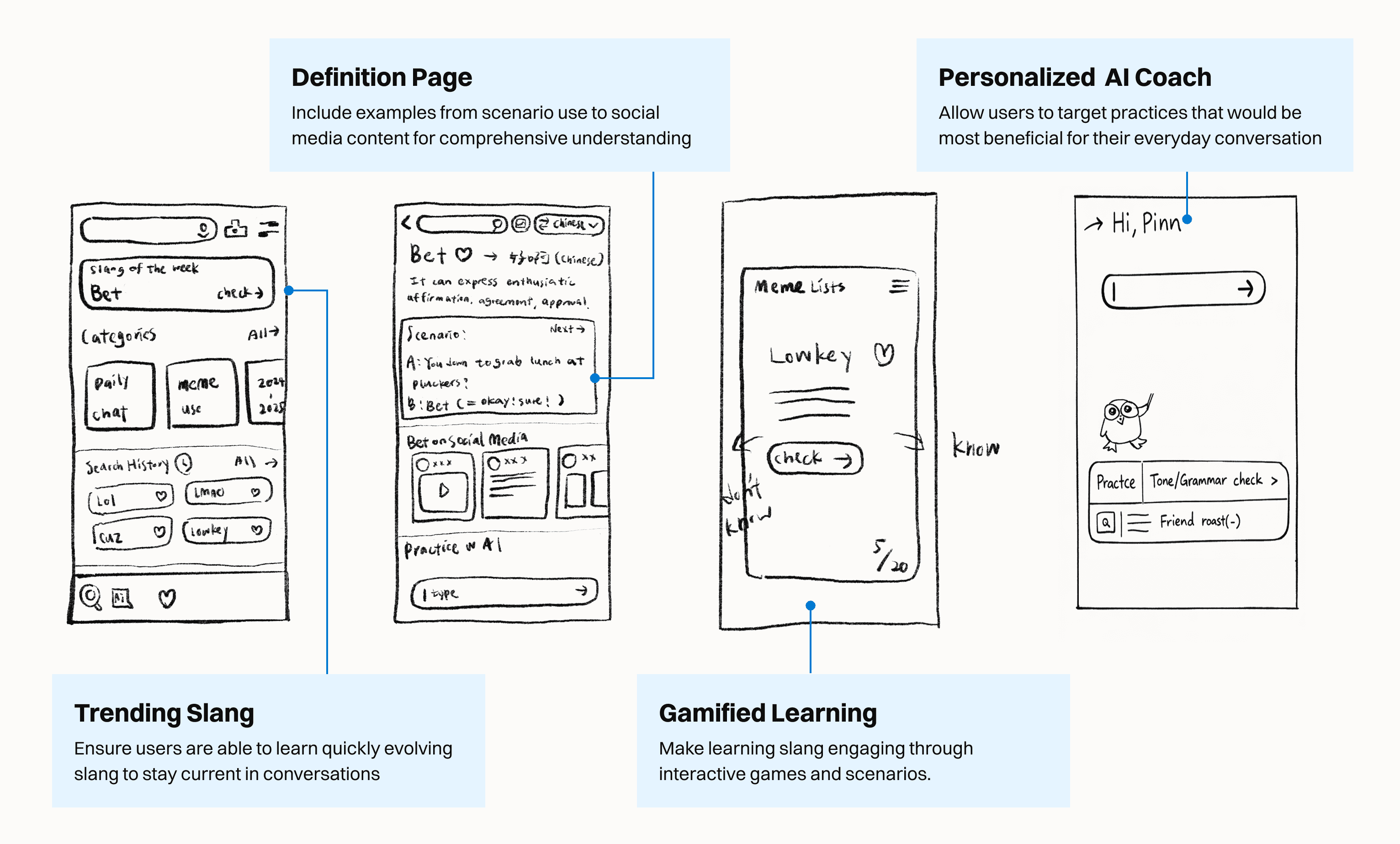
We tested key features to learn what users expected each action to do and what they thought, using open-ended questions to capture their natural interpretations early.
Providing more context meaning after searching slang
Beyond translation, provides more context to the meaning like how to use it, examples, and video clips related to it.
AI-guided slang learning with FRed
FRed, an AI personal tutor that guides slang learning, helps users practice slang through topic-based, real-life conversations, while the Learning page lets users explore and save slang.
A community hub for trending slang and daily friend challenges
Monthly slang trends, a share slang post feature, and users can challenge friends to guess the meaning through daily challenge.
Screenshot to slang lookup without switching apps
Share a screenshot to instantly detect and translate slang.
Mid-Fi PROTOTYPE
Users understood the features differently than we expected!
After our first round of testing with target users, we validated the core concept and synthesized feedback into three key issues, which helped us refine and focus the product direction.
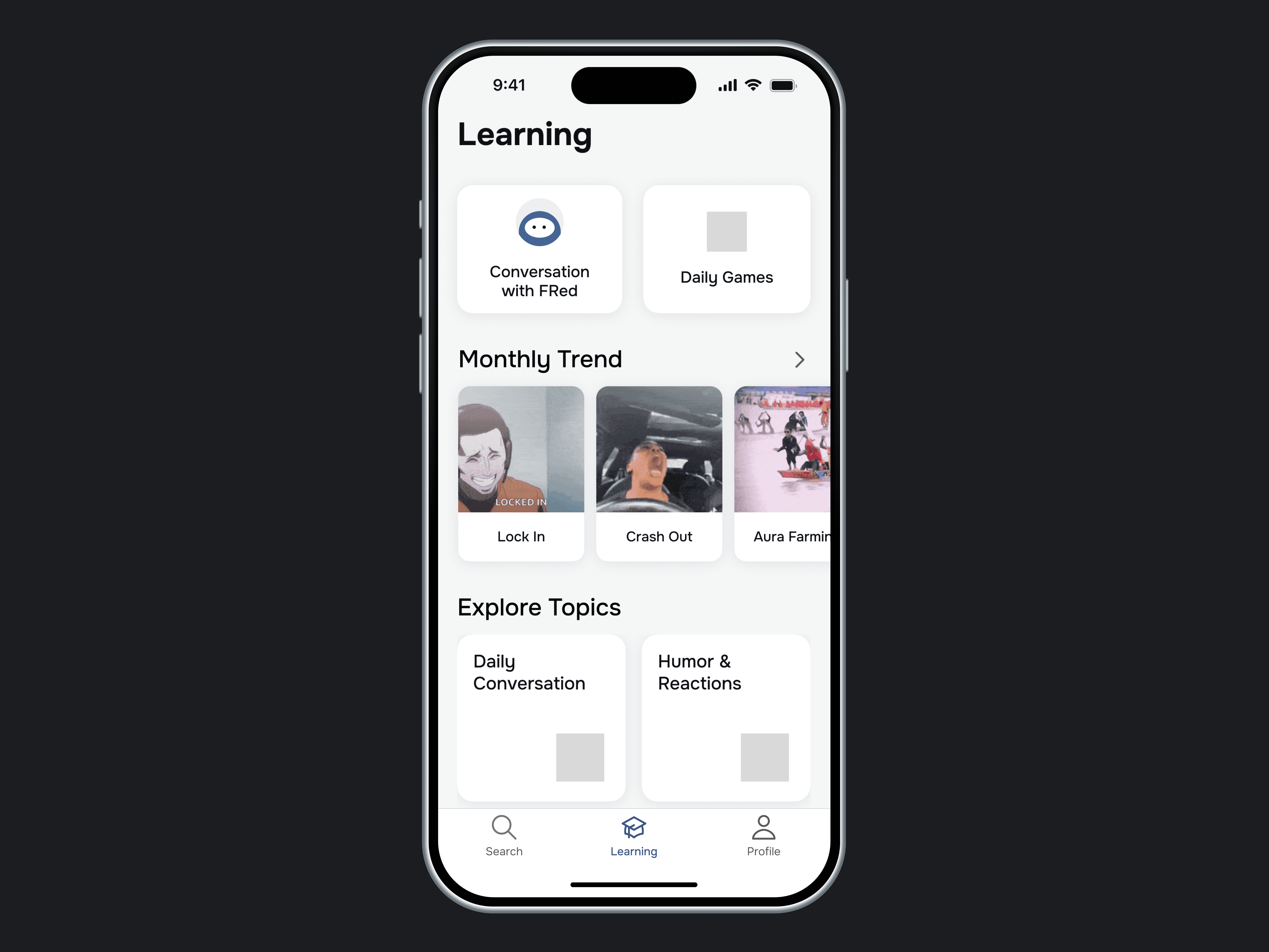
Issue 1: Users couldn’t tell the difference between Learn and Community, and the features felt redundant and unengaging.
💡 SOLUTION…
Removed the Community page and embedded social interactions into games
We reorganized overlapping features into Learning and Daily Games, users can find content faster and stay motivated through multiple practice formats.
Issue 2: Users questioned the credibility of slang content in the app
💡 SOLUTION…
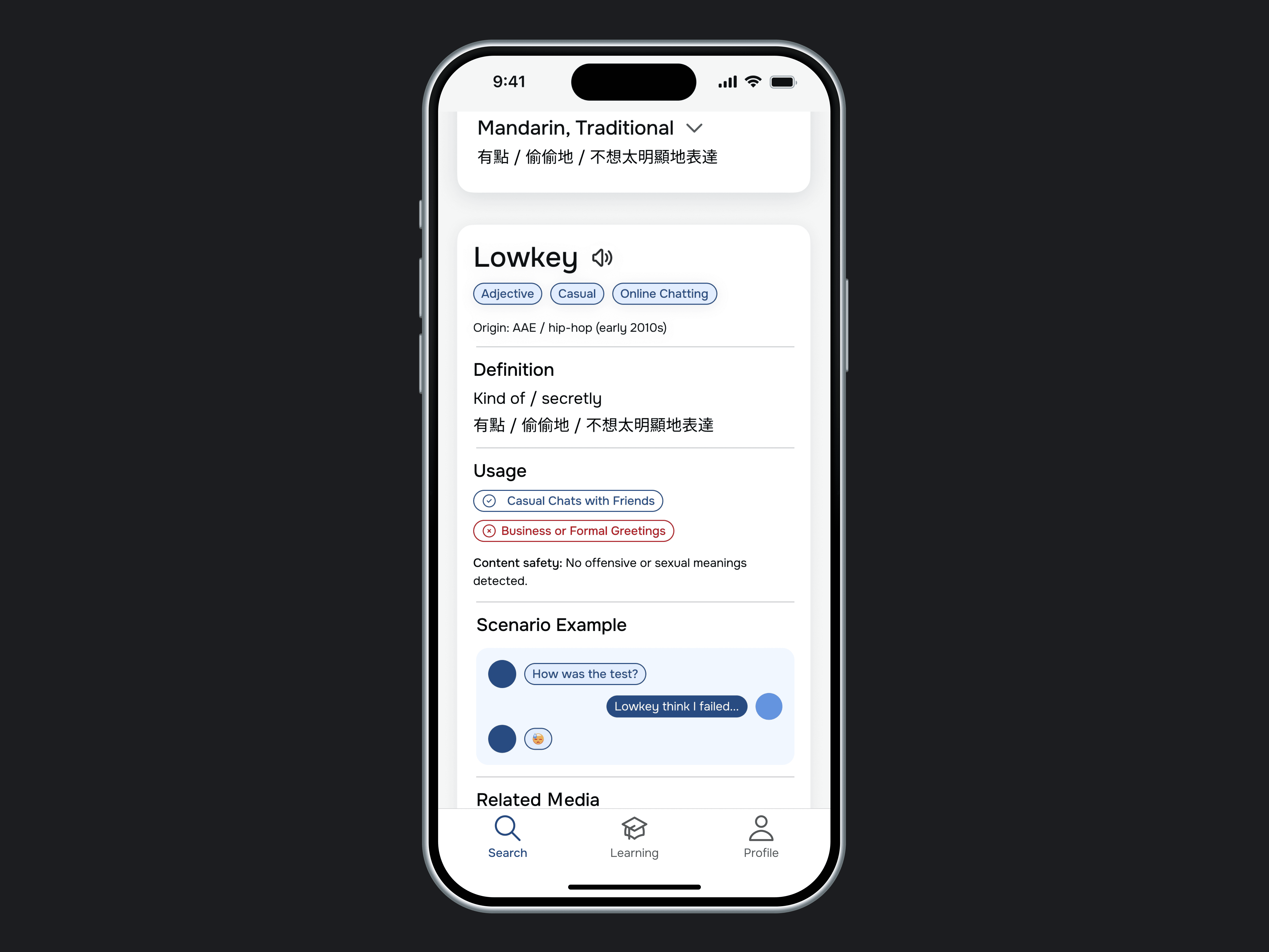
Strengthened trust with curated slang sources and clear usage context
We removed the share slang post feature, and added clear slang sources and usage context ,like tone, appropriateness, and real-life examples to improve accuracy.
Issue 3: FRed's purpose wasn't clear, so user didn't know how to use it
💡 SOLUTION…
Clarified FRed’s purpose with two AI modes and added onboarding guidance
Ask FRed supports quick questions inside slang cards, and Conversation with FRed enables topic-based scenario practice.
FINAL DESIGN
Refined through two rounds of user testing
After two rounds of user testing shaped the iteration to the final version, I finalized the UI, built the high-fidelity prototype, and ran additional unmoderated tests on the final design to synthesize insights into the project outcomes.
Introducing FRed and screenshot lookup feature through onboarding
A search experience that turns lookup into in-context learning
Learning slang by topic with lightweight practice
Lets users practice real-life chats naturally, with clear corrections and suggestions
OUTCOME
Final unmoderated test shows positive feedback after iteration
To validate whether the final design truly addressed the issues, we conducted 9 unmoderated tests. Aside from a few technical problems, most users gave the design highly positive feedback and strong usability data.
90%
90%
Task Completion
Task Completion
4.7 / 5
4.7 / 5
Average SEQ
Average SEQ
<
<
5%
5%
Of Tasks Showed Difficulty
Of Tasks Showed Difficulty
IYKYK;) Shout-out to my team: Pinn, Anna, and Santa!!
REFLECTION
Design tradeoff
Designing the AI practice feature was one of our biggest challenges. We wanted FRed to function as a learning-focused AI coach rather than being perceived or used like AI tools, so we intentionally limited its capabilities. But tighter constraints could reduce authentic typing practice and personalized responses, creating a constant tradeoff between control, realism, and user expectations for flexibility.
Start bold, validate fast.
Despite the challenges, we stayed focused on our core value by simplifying flows and keeping the learning experience clean and lightweight. I’m especially proud of the screenshot translation feature, which testers consistently found intuitive and helpful for understanding real-time slang. This project taught me to start with bold assumptions, then validate fast and refine through iteration, usability testing, and prioritization.
Free free to reach out
© 2026
Designed with ❤️🔥 in Austin
Free free to reach out
© 2026
Designed with ❤️🔥 in Austin
TalkFR • Academic Project 2025
Designing for real talk beyond translation into meaning
TalkFR ( Talk For Real ) is an AI- powered slang-learning app designed to help international student or ESL ( English as Second Language ) learner confidently understand and use contemporary English expressions in real-life communication.
ROLE
Lead Product Designer
TIMELINE
4 months, 2025
TEAM
Lead Product Designer ( me )
1 User Researcher
2 Designers
PROJECT TYPE
App Design
Edtech
WHAT I DID
• Led product design and visual design from concept to 7+ high- fidelity prototype.
• Conducted 2 user interviews and 3 moderated usability tests to validate flows and usability issues.
• Developed a design system that improved speed, consistency, and collaboration across the team.
BACKGROUND
What if we leveraged AI to provide personalized slang tutoring, helping learners go from not sure to confident in real talk?
International students often learn formal English but struggle with the informal expressions that native speakers use every day, such as slang, internet abbreviations, and casual conversational phrases, making it difficult to understand jokes, follow social interactions, and participate in casual conversations. This gap for feeling socially isolated, less confident in speaking was the starting point for TalkFR.
SOLUTION
TalkFR: An AI-powered slang tutor providing tailored feedback and guidence.
Learn slang with usage, scenarios and related media
Provides tailored AI learning modes based on user context
Instantly lookup the slang word without switching the app
INITIAL OBSERVATION
Nearly 80% of respondents have pretend to understand slang because they don’t want to interrupt the flow of the conversation.
We conducted user survey and user Interview with non-native english speakers to ensure that we were addressing our users’ needs and uncover pain points:
32
Survey respondents
5
Depth user interviews
PAIN POINTS:
1. Lack of strategies for learning slang
Most time stop at one-time translation. Users want ongoing learning and simple ways to explore more related slang.
Uncertainty about slang usage
Even when users understand the meaning, they still hesitate to use slang because they’re unsure about tone, politeness, and fear sounding awkward.
3. Slang lookup creates friction
Switching between multiple apps to search slang breaks immersion so that users often give up looking it up.
COMPETITOR ANALYSIS
Guided Slang Learning in Real-Life Contexts
We mapped language-learning apps, translators, and dictionaries across two dimensions. Slang in real-life context and level of practice & guidance to identify where TalkFR can uniquely deliver slang-first learning beyond one-time lookup.
Most tools end at lookup or focus on standard language practice, here are key opportunities that TalkFR is designed to filled:
1. Interactive slang practice
Few competitors offer real-time, contextual slang practice. TalkFR can fill this gap with AI chat and games.
Cultural differences and taboos
Provide cultural notes to prevent misuse, such as flagging when certain slang may be offensive or only used within specific groups.
3. Slang trend updates
Introduce new slang terms and their meanings, proactively helping users stay up to date with the latest usage.
“ How might we turn a quick slang lookup into an ongoing, personalized learning experience? ”
DESIGN PROCESS
Validated key decisions with rapid testing to iterate the product direction quickly.
INITIAL IDEAS
Key features: Searching, Learning, and Tutoring
Based on our initial observation, we started brainstorming with these key features: Search Feature for users to quickly find definitions and examples, Game/Learning Hub to practice using slang, and a TalkFR Mascot to be a personal coach on the user’s learning journey.
LO-FI WIREFRAMES & TEST
Validate the concept and direction early
We tested key features to learn what users expected each action to do and what they thought, using open-ended questions to capture their natural interpretations early.
Providing more context meaning after searching slang
Beyond translation, provides more context to the meaning like how to use it, examples, and video clips related to it.
AI-guided slang learning with FRed
FRed, an AI personal tutor that guides slang learning, helps users practice slang through topic-based, real-life conversations, while the Learning page lets users explore and save slang.
A community hub for trending slang and daily friend challenges
Monthly slang trends, a share slang post feature, and users can challenge friends to guess the meaning through daily challenge.
Screenshot to slang lookup without switching apps
Share a screenshot to instantly detect and translate slang.
Mid-Fi PROTOTYPE
Users understood the features differently than we expected!
After our first round of testing with target users, we validated the core concept and synthesized feedback into three key issues, which helped us refine and focus the product direction.
Issue 1: Users couldn’t tell the difference between Learn and Community, and the features felt redundant and unengaging.
💡 SOLUTION…
Removed the Community page and embedded social interactions into games
We reorganized overlapping features into Learning and Daily Games, users can find content faster and stay motivated through multiple practice formats.
Issue 2: Users questioned the credibility of slang content in the app
💡 SOLUTION…
Strengthened trust with curated slang sources and clear usage context
We removed the share slang post feature, and added clear slang sources and usage context ,like tone, appropriateness, and real-life examples to improve accuracy.
Issue 3: FRed's purpose wasn't clear, so user didn't know how to use it
💡 SOLUTION…
Clarified FRed’s purpose with two AI modes and added onboarding guidance
Ask FRed supports quick questions inside slang cards, and Conversation with FRed enables topic-based scenario practice.
FINAL DESIGN
Refined through two rounds of user testing
After two rounds of user testing shaped the iteration to the final version, I finalized the UI, built the high-fidelity prototype, and ran additional unmoderated tests on the final design to synthesize insights into the project outcomes.
Introducing FRed and screenshot lookup feature through onboarding
A search experience that turns lookup into in-context learning
Learning slang by topic with lightweight practice
Lets users practice real-life chats naturally, with clear corrections and suggestions
OUTCOME
Final unmoderated test shows positive feedback after iteration
To validate whether the final design truly addressed the issues, we conducted 9 unmoderated tests. Aside from a few technical problems, most users gave the design highly positive feedback and strong usability data.
90%
Task Completion
4.7 / 5
Average SEQ
<
5%
Of Tasks Showed Difficulty
IYKYK;) Shout-out to my team: Pinn, Anna, and Santa!!
REFLECTION
Design tradeoff
Designing the AI practice feature was one of our biggest challenges. We wanted FRed to function as a learning-focused AI coach rather than being perceived or used like AI tools, so we intentionally limited its capabilities. But tighter constraints could reduce authentic typing practice and personalized responses, creating a constant tradeoff between control, realism, and user expectations for flexibility.
Start bold, validate fast.
Despite the challenges, we stayed focused on our core value by simplifying flows and keeping the learning experience clean and lightweight. I’m especially proud of the screenshot translation feature, which testers consistently found intuitive and helpful for understanding real-time slang. This project taught me to start with bold assumptions, then validate fast and refine through iteration, usability testing, and prioritization.
Free free to reach out
© 2026
Designed with ❤️🔥 in Austin